


Executive Summary
The NIST Artificial Intelligence Risk Management Framework (AI RMF) provides organizations with a practical framework for managing AI-related risk and building trustworthy, responsible AI programs. Developed by the National Institute of Standards and Technology, the AI RMF helps organizations strengthen AI governance, improve AI security and compliance readiness, establish operational oversight, and support transparent, accountable AI adoption. Built around four core functions (Govern, Map, Measure, and Manage), the framework enables organizations to align AI innovation with risk management, privacy, fairness, explainability, and long-term business objectives.
A Practical Framework for Trustworthy and Responsible AI
Artificial intelligence is rapidly reshaping business operations, customer engagement, analytics, cybersecurity, and decision-making. But as AI adoption accelerates, so do concerns surrounding security, bias, privacy, transparency, governance, and regulatory compliance,
To help organizations manage these challenges, the National Institute of Standards and Technology developed the NIST Artificial Intelligence Risk Management Framework (AI RMF), a voluntary framework that supports organizations in developing, deploying, and using AI responsibly.
The AI RMF provides a flexible, practical approach for organizations of all sizes to manage AI risk while promoting trustworthy AI outcomes.
Learn more at NIST AI RMF Resources.
NIST AI RMF Adoption Is Widespread
With over 75% of organizations now using AI in at least one business function, the need for formal governance has accelerated. The NIST AI RMF has emerged as a de facto standard for managing AI risk, helping organizations embed trust, transparency, and accountability across the AI lifecycle.¹²
Why AI Governance and AI Risk Management Matter
AI systems can create enormous value, but they can also introduce new operational, legal, security, and reputational risks.
Potential risks include:
- Inaccurate or unreliable outputs
- Bias and discrimination
- Privacy and data protection concerns
- Security vulnerabilities
- Lack of explainability or transparency
- Compliance and regulatory exposure
The AI RMF helps organizations proactively identify and manage these risks throughout the AI lifecycle rather than reacting after problems emerge.
The Four Core Functions of AI Governance and Operational Risk Management
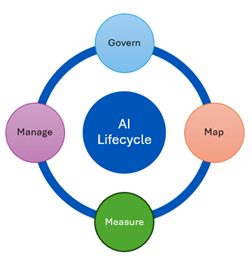
The framework is built around four continuous risk management functions:
- Govern: Establish policies, oversight, accountability, and governance processes for AI initiatives.
- Map: Understand AI use cases, stakeholders, data sources, operational context, and potential impacts.
- Measure: Assess AI systems for accuracy, fairness, security, explainability, privacy, and reliability.
- Manage: Prioritize, mitigate, monitor, and respond to AI-related risks over time.
Together, these functions create a lifecycle-based approach to AI governance and operational risk management.
Characteristics of Trustworthy and Responsible AI Systems
A major strength of the AI RMF is its focus on trustworthy AI. According to NIST, trustworthy AI systems should strive to be:
- Valid and reliable
- Safe and secure
- Accountable and transparent
- Explainable and interpretable
- Privacy-enhanced
- Fair, with harmful bias managed
These principles help organizations align AI initiatives with both business objectives and ethical responsibilities.
Resources for AI Governance, AI Compliance, and Responsible AI Adoption
NIST provides several companion resources to help organizations operationalize the framework.
AI RMF Playbook
The NIST AI RMF Playbook provides actionable guidance to help organizations operationalize the AI Risk Management Framework. It translates the framework’s core functions into practical implementation steps, offering suggested actions, documentation approaches, and real-world considerations for integrating AI risk management into existing processes.
Organizations can use the Playbook to:
- Navigate implementation activities with step-by-step guidance aligned to AI RMF functions and categories
- Strengthen AI governance workflows by embedding risk management practices into development, deployment, and operational processes
- Support lifecycle documentation through recommended artifacts, traceability practices, and audit-ready records
- Align cross-functional teams around shared AI risk management objectives, roles, and responsibilities
- Enable continuous improvement by providing a flexible structure that evolves with organizational maturity and emerging AI risks
By bridging strategy and execution, the Playbook helps organizations move beyond conceptual guidance to establish repeatable, scalable practices for managing AI risk across the entire lifecycle.
Access the Playbook at NIST AI RMF Playbook.
AI RMF Roadmap
The NIST AI Risk Management Framework Roadmap outlines priority actions to advance AI risk management practices across both public and private sectors. It identifies key focus areas, including standards development, governance models, measurement and evaluation methodologies, and expanded industry-academic collaboration. The Roadmap also reflects NIST’s ongoing commitment to evolving the framework in step with rapidly advancing AI capabilities, helping organizations operationalize responsible, trustworthy AI over time.
View the roadmap at NIST AI RMF Roadmap.
AI RMF Crosswalks
AI RMF Crosswalks provide practical guidance for aligning the framework with existing cybersecurity, privacy, and governance standards, including NIST CSF, ISO frameworks, and other regulatory frameworks. By mapping common controls and principles, crosswalks help organizations integrate AI risk management into established compliance programs, reducing duplication of effort while improving consistency, traceability, and audit readiness. This alignment accelerates adoption and enables a more unified, enterprise-wide approach to managing AI risk.
Explore the crosswalk resources at NIST AI RMF Crosswalks.
NIST AI Resource Center (AIRC)
To accelerate the adoption of trustworthy and responsible AI practices, NIST established the AI Resource Center (AIRC) as a centralized, authoritative hub for AI guidance and supporting materials. The AIRC brings together a broad set of resources designed to help organizations operationalize the NIST AI Risk Management Framework (AI RMF) and strengthen AI governance across the lifecycle.
The AIRC provides access to:
- AI standards and frameworks to guide responsible design, development, and deployment
- Technical guidance supporting the implementation of AI risk management practices
- Metrics and evaluation tools to assess model performance, bias, robustness, and trustworthiness
- Risk management resources aligned to the AI RMF for identifying, measuring, and mitigating AI-related risks
- Educational materials to build organizational awareness and maturity in AI governance
- Use cases and implementation examples that demonstrate practical application across industries and public-sector environments
By consolidating these resources in a single location, the AIRC enables organizations to more efficiently adopt AI governance best practices, improve consistency, and accelerate the deployment of secure, transparent, and trustworthy AI systems.
Dive deeper into AIRC guidance at NIST AI Resource Center (AIRC).
How the NIST AI RMF Supports Responsible AI Adoption
Organizations adopting the AI RMF can benefit from:
- Stronger AI governance and accountability
- Reduced operational and compliance risk
- Improved stakeholder trust
- Better alignment between business, legal, security, and technical teams
- Greater readiness for evolving AI regulations
- More scalable and responsible AI adoption
As AI becomes more embedded in business operations, organizations need governance models that balance innovation with accountability and risk management.
The NIST Artificial Intelligence Risk Management Framework (AI RMF) provides a practical foundation for building trustworthy and responsible AI programs, while the NIST Trustworthy and Responsible AI Resource Center offers the tools and resources organizations need to put those principles into practice.
Organizations that establish strong AI governance today will be better positioned to innovate confidently, reduce risk, and build long-term trust in their AI initiatives.
Build a Trustworthy Foundation for AI Adoption
Successfully adopting AI requires more than deploying new tools; it requires governance, risk management, security, and a clear strategy for responsible use. Cerium Networks helps organizations align AI innovation with the NIST Artificial Intelligence Risk Management Framework (AI RMF) to support secure, trustworthy, and scalable AI adoption.
Cerium’s customized AI workshops help IT teams, business leaders, and department stakeholders better understand AI risks, governance models, operational requirements, and implementation strategies. Through hands-on guidance and real-world use cases, organizations gain actionable insight into developing AI policies, managing risk, improving governance, and building a roadmap for responsible AI integration.
Whether your organization is evaluating AI initiatives or expanding existing AI programs, Cerium can help you move forward with greater confidence, stronger governance, and a practical framework for long-term success.
Frequently Asked Questions About the
NIST AI RMF
The NIST Artificial Intelligence Risk Management Framework (AI RMF) is a voluntary framework developed by the National Institute of Standards and Technology to help organizations identify, assess, manage, and govern AI-related risks throughout the AI lifecycle.
The framework is built around four continuous functions:
- Govern
- Map
- Measure
- Manage
Together, these functions support AI governance, operational oversight, and continuous AI risk management.
No. The AI RMF is voluntary and designed to provide flexible guidance to organizations of all sizes and industries seeking to implement trustworthy, responsible AI practices.
The framework helps organizations address critical areas, including AI security, fairness, transparency, explainability, privacy, accountability, and operational risk management, to support the adoption of trustworthy AI.
The framework can benefit enterprises, government agencies, educational institutions, healthcare organizations, technology providers, and any organization that develops, deploys, or manages AI systems.
The NIST Trustworthy and Responsible AI Resource Center is a centralized platform that provides implementation guidance, standards, technical resources, metrics, use cases, and educational materials to help organizations operationalize the AI RMF.
Yes. The AI RMF Crosswalks help organizations align AI governance initiatives with existing cybersecurity, privacy, governance, risk management, and compliance frameworks.
Organizations can access the framework, Playbook, and additional implementation resources through:
References
- Net Solutions, Enterprise Guide to the NIST AI Risk Management Framework, July 2025 [netsolutions.com]
- GLACIS, NIST AI RMF Implementation Guide, April 2026 [glacis.io]
NIST AI Risk Management Resources:
Practical implementation guidance for applying AI RMF functions across the AI lifecycle.
Priority areas for advancing AI risk management, standards, governance, and collaboration.
Helps organizations align AI RMF with existing cybersecurity, privacy, and compliance frameworks.
Helps organizations align AI RMF with existing cybersecurity, privacy, and compliance frameworks.