

Executive Summary
Cisco is evolving its security portfolio to be AI-native, agentic, and deeply integrated across networking, identity, and observability. This shift is driven by two realities: adversaries are already using AI, and traditional human-scale security operations can no longer keep up.
Cisco’s transformation centers on three pillars:
- AI Everywhere: Detection, response, policy, and infrastructure are AI-native
- Agentic Operations: Autonomous AI agents investigate and respond at machine speed
- Security for AI: AI agents, identities, and workloads are first-class security concerns
KEY INSIGHT:
AI is no longer an enhancement to cybersecurity; it is the foundation of effective defense.
Pillar | What it Means | Business Outcome |
|---|---|---|
AI Everywhere | AI embedded across security and infrastructure | Faster, scalable protection |
Agentic Ops | Autonomous investigation and response | Reduced MTTD / MTTR |
Security for AI | AI agents treated as identities | Safer AI adoption |
From Tool-Centric Security to AI-Driven Security Platforms
Cisco is consolidating its security offerings into a unified Security Cloud powered by AI, telemetry, and automation¹.
- Cisco processes hundreds of billions of security events per day, using this data to train AI models for faster and more accurate threat detection²³
- AI is embedded across firewall, XDR, identity, email, endpoint, and cloud security, not bolted on
Why This Matters:
Security outcomes improve when AI operates across networks, identities, endpoints, and the cloud rather than in isolated tools.
Agentic AI and the Autonomous Security Operations Center (SOC)
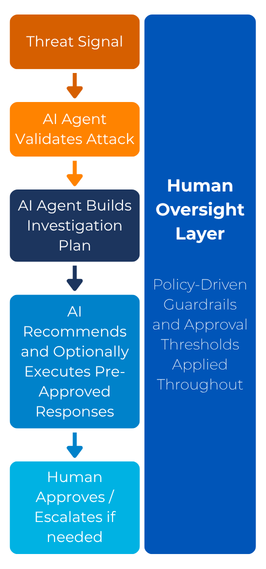
Cisco is evolving beyond traditional AI assistants toward agentic AI, including autonomous security agents capable of executing complex, multi‑step workflows end to end, while still operating under human-defined intent and oversight. This shift is foundational to Cisco’s vision of an Autonomous SOC, where routine investigation and response tasks are handled at machine speed, allowing human analysts to focus on judgment, escalation, and strategic decisions.
Cisco XDR and Splunk: Agentic AI in Action
Cisco XDR, tightly integrated with Splunk, applies agentic AI to orchestrate and automate the full incident lifecycle:
- Attack Validation: Autonomous agents rapidly assess alerts to distinguish real threats from noise, reducing false positives and analyst fatigue.
- Investigation Planning: The system dynamically builds investigation paths across users, devices, networks, and workloads without requiring manual correlation.
- Response Execution: Based on policy and confidence levels, agentic AI can initiate containment or remediation actions such as isolating endpoints, blocking indicators, or escalating incidents for human approval⁴⁵.
Instant Attack Verification
Cisco XDR’s Instant Attack Verification capability correlates multiple high‑value telemetry sources to confirm active threats in minutes rather than hours or days:
- Splunk log and event data
- Network telemetry
- Endpoint activity
- Curated threat intelligence
By validating attacks through cross-domain evidence, the platform dramatically shortens mean time to detect (MTTD) and ensures analysts engage only with confirmed, high‑fidelity incidents⁵.
XDR Storyboard: From Signals to Understanding
To bridge the gap between machine-driven analysis and human decision-making, XDR Storyboard converts complex attack chains into clear, human‑readable narratives. It visually and textually explains:
- How an attack unfolded
- Which assets were involved
- What actions were taken automatically
- Where human intervention is recommended
This narrative-driven approach improves analyst confidence, accelerates response approvals, and supports auditability, which is critical in regulated and public-sector environments.
Business Impact
Together, agentic AI, Cisco XDR, and Splunk enable a more scalable and resilient SOC model. This approach positions Cisco’s security platform not just as an AI‑assisted toolset, but as a coordinated, semi‑autonomous security partner that augments human expertise rather than replacing it.
Why This Matters:
SOC teams shift from manual triage to decision-making, while AI handles investigation at machine speed.
AI-Native Infrastructure Security: Cisco Hypershield
Cisco Hypershield represents a significant architectural shift from perimeter‑based security toward embedded, AI‑native protection built directly into the infrastructure itself⁶. Rather than bolting security tools onto the network, Hypershield integrates enforcement and intelligence at the point where traffic is created, processed, and consumed.
Key Insight:
The firewall is evolving from a rules engine into an adaptive, learning system.
Built‑In, Not Bolted‑On
With Hypershield, security controls are distributed across the infrastructure stack, including:
- Network switches, enabling enforcement at line rate
- Servers, providing deep visibility and local control
- Workloads, extending protection into cloud‑native and hybrid environments
This approach reduces dependency on centralized inspection points and improves both performance and resilience.
Advanced Enforcement and Automation Technologies
Hypershield leverages modern, low‑level, and hardware‑accelerated technologies to enable adaptive security at scale:
- eBPF (extended Berkeley Packet Filter), a low‑level technology that allows security, networking, and observability logic to run safely and dynamically inside the operating system, without modifying kernel code, for real‑time visibility and policy enforcement within the operating system
- DPUs (Data Processing Units), specialized hardware processors designed to offload networking, security, and infrastructure services from the main CPU and enforce controls closer to the data path
- AI‑driven automation to continuously assess risk and adjust protections dynamically
AI‑Driven, Real‑Time Protection
Using these building blocks, Hypershield applies AI to operate at machine speed:
- Analyze live traffic and behavior across infrastructure layers
- Automatically generate compensating controls when vulnerabilities or threats are detected
- Safely test policies before activation to reduce operational risk
- Deploy new or updated protections within minutes rather than days or weeks⁶⁷
What Makes It Different
Traditional infrastructure security relies on static rules and manual updates. Hypershield introduces a fundamentally different model where security policies are adaptive and self-operating. These policies can:
- Write themselves, based on observed behavior and risk context
- Validate themselves, ensuring they function as intended, before full enforcement
- Deploy themselves, reducing human delay while maintaining oversight⁸
Impact
This AI‑native approach enables organizations to move faster without sacrificing control—supporting zero trust, reducing exposure windows, and aligning infrastructure security with the speed and complexity of modern applications.
Securing AI: Identities, Models, and Agents
As organizations adopt AI at scale, Cisco is broadening its security focus from using AI to improve security toward securing AI itself, including the identities, models, and autonomous agents now operating across enterprise environments
AI agents often act faster and with broader access than human users, amplifying the impact of misconfigurations or misuse. Cisco’s AI security strategy brings governance, least privilege, and continuous monitoring to these new digital actors, reducing risk without slowing innovation.
Key Insight:
AI agents must be treated like users, with identity management, access controls, and continuous monitoring.
Protecting AI Agents and Non‑Human Identities
With the acquisition of Astrix Security (May 2026), Cisco expanded its security capabilities to cover AI agents and non-human identities. These entities can access data, take actions, and connect with business systems independently⁹. Because they often operate outside traditional Identity and Access Management (IAM) visibility, they can introduce new security risks if not properly managed.
Unified Visibility and Control
Cisco is integrating AI identity security into its broader security platform, including:
- Identity Intelligence for behavior‑based identity risk analysis
- Duo for strong authentication and access controls
- Secure Access for zero trust enforcement
- Splunk for centralized visibility, analytics, and auditing
This integrated approach enables organizations to see:
- What AI agents are doing
- What systems and data they can access
- Whether agents are overprivileged or behaving abnormally
Impact
By securing AI at the identity and behavior level, Cisco enables organizations to:
- Safely operationalize AI agents
- Limit blast radius through privilege control
- Maintain auditability and policy compliance
- Scale AI adoption with confidence
Why This Matters:
According to Cisco’s Cybersecurity Readiness Index, 86% of organizations have already experienced AI‑related security incidents⁴, underscoring the urgency of securing AI identities and agents with the same rigor as human users.
Cisco AI Assistant for Security: Human-in-the-Loop AI
Cisco’s AI Assistant for Security is designed to function as a security copilot, augmenting human analysts rather than replacing them¹⁰. It embeds AI directly into security workflows to accelerate investigation, decision‑making, and response while ensuring analysts remain accountable for critical judgments and actions
Key Insight:
Cisco’s model is Human → AI → Human (HAIH), preserving trust while accelerating action.
Analyst‑Centered Capabilities
AI Assistant supports security teams by enabling:
- Natural language queries, allowing analysts to ask complex security questions without specialized syntax
- Policy analysis, helping teams understand the impact of existing or proposed controls
- Root cause investigation, correlating signals across environments to explain why an incident occurred
- Automated remediation recommendations, with optional execution based on analyst approval
This approach reduces friction and investigation time while preserving human control and oversight.
Intelligence at Scale
Cisco’s AI Assistant is trained on insights derived from over 550 billion security events processed daily across Cisco’s global telemetry footprint²³. This scale enables the assistant to:
AI Automation with Human Accountability Built In
- Recognize patterns that individual tools or teams cannot see
- Contextualize alerts within broader threat activity
- Continuously improve accuracy as threat behaviors evolve
Built for Trust and Transparency
Unlike opaque “black box” AI systems, Cisco’s AI Assistant emphasizes explainability and transparency, providing:
- Clear reasoning behind recommendations
- Traceable decision logic that analysts can validate
- Confidence in outcomes for audit, compliance, and regulated environments
Impact
By combining large‑scale intelligence with human‑in‑the‑loop design, Cisco’s AI Assistant helps organizations:
- Reduce investigation and response time
- Improve analyst efficiency without increasing risk
- Maintain trust, accountability, and governance
- Operationalize AI safely within security operations
Open Ecosystems and Responsible AI
Cisco is deliberately investing in an open, interoperable, and responsible AI security ecosystem, recognizing that trust, transparency, and collaboration are essential as AI becomes embedded in security and infrastructure operations.
Open Security Models: Foundation AI
Introduced at RSAC 2025, Cisco Foundation AI reflects Cisco’s commitment to openness through open‑source reasoning models purpose‑built for security use cases⁴⁵. By making reasoning logic visible and inspectable, Foundation AI:
- Enables greater transparency into how AI arrives at conclusions
- Supports independent validation and community collaboration
- Reduces reliance on opaque, black‑box security models
This open approach aligns with public‑sector, enterprise, and regulated‑industry requirements for explainability and auditability.
Responsible AI by Design
Cisco’s Responsible AI Framework establishes guardrails that ensure AI deployment enhances security without introducing unnecessary risk³. Core principles include:
- Transparency, so decisions and recommendations can be understood and trusted
- Privacy, protecting sensitive data used to train or operate AI systems
- Controllable autonomy, ensuring humans define intent, scope, and escalation boundaries
These principles reinforce Cisco’s human‑centered approach to AI, balancing automation with governance and oversight.
Ecosystem‑First Integration Strategy
Rather than locking customers into proprietary silos, Cisco designs its AI and security capabilities to integrate smoothly with leading platforms, including:
- ServiceNow, aligning AI‑driven security insights with IT and security workflows
- Splunk, providing centralized analytics, context, and operational visibility
- NVIDIA, leveraging accelerated computing to support advanced AI workloads and real‑time inference⁴⁷
This ecosystem‑driven model allows organizations to operationalize AI security within their existing tools and processes.
Impact
By combining open models, responsible governance, and deep ecosystem integration, Cisco enables organizations to:
- Adopt AI securely and transparently
- Maintain flexibility and vendor interoperability
- Meet regulatory, audit, and ethical expectations
- Scale AI innovation without sacrificing trust
Why Cisco’s Approach Matters
Organizations embracing generative AI, hybrid cloud, and Zero Trust architectures are operating in environments where scale, complexity, and speed exceed the capabilities of traditional, human‑centric security models. Adversaries already exploit automation and AI; defenders must respond at the same pace to remain effective.
Cisco’s AI‑native security platform is designed for this reality. It delivers:
- Cross‑domain visibility across networking, identity, endpoints, applications, and cloud that turns fragmented signals into actionable context
- Autonomous, agentic response that validates threats and executes policy‑driven actions at machine speed, with human oversight
- AI identity governance that treats human and non‑human identities, including AI agents, as first‑class security entities
- Continuous adaptation, where policies and protections evolve dynamically as environments and threats change
Together, these capabilities enable organizations to adopt modern architectures with confidence and scale security operations without sacrificing control, transparency, or trust.
From AI Innovation to Measurable Security Outcomes
AI-driven threats demand a fundamentally new approach to security, and Cisco’s AI-native, agentic security platform is at the forefront of that transformation. As a long-standing Cisco Preferred Partner, Cerium Networks helps organizations turn Cisco’s innovations into tangible security results. From modernizing identity and access management to deploying AI-native threat detection and enabling agentic response, Cerium brings proven expertise in integrating, securing, and optimizing your environment. If you’re ready to move beyond reactive security and operationalize AI-powered defenses, Cerium can help you build a smarter, faster, and more resilient security posture with Cisco.
Footnotes:
- Cisco Security Cloud Overview – https://www.cisco.com/site/us/en/products/security/security-cloud.html
- UC Today – https://www.uctoday.com
- Help Net Security – https://www.helpnetsecurity.com
- Futurum Group – https://www.futurumgroup.com
- Network World – https://www.networkworld.com
- Cisco Hypershield – https://www.cisco.com/c/en/us/products/security/hypershield.html
- Cybersecurity News – https://cybersecuritynews.com
- Networkers Home – https://networkershome.com
- SiliconANGLE – https://siliconangle.com
- Cisco AI Assistant – https://www.cisco.com/c/en/us/products/security/ai-assistant.html