

Organizations that achieve the greatest ROI from AI will focus less on model names and benchmark scores and more on matching the right AI capability to each business outcome at the lowest practical cost.
Every few weeks, another AI model arrives promising to be faster, smarter, or better at reasoning than the last. OpenAI continues expanding its GPT family with specialized models. Anthropic positions Sonnet as its efficient everyday workhorse while reserving its more advanced models, Opus and Fable, for complex reasoning and coding. Google, Microsoft, and others are taking a similar approach, building portfolios of models optimized for different tasks instead of pursuing a single “best” model.
At the same time, platforms like Microsoft Copilot increasingly hide those differences through automatic model selection. As AI becomes easier to use, many organizations are asking a simple question:
Do I need to care which AI model I use, or can I trust Auto mode?
It’s a timely question, especially as AI vendors shift toward consumption-based pricing and agent-driven services where every request carries a measurable cost. The answer, however, may be surprising.
For most business users, selecting a model will become less important over time, not more. The real advantage won’t come from memorizing model names or chasing benchmark scores. It will come from understanding when advanced reasoning is genuinely needed and when a faster, lower-cost model can deliver the same business outcome.
That means many organizations are asking the wrong question. Instead of wondering:
- Is GPT better than Claude?
- Is the newest reasoning model worth the upgrade?
- Which model tops the latest benchmark?
They should be asking:
Which model delivers the best outcome for this task with the lowest cost, time, and effort?
The New AI Arms Race
The first wave of generative AI focused on chatbots that answered questions and generated content. The next wave is about AI agents that can plan, reason, use tools, and complete multi-step workflows with minimal human intervention.
That evolution is reshaping how AI providers build and deliver their models. Instead of relying on a single flagship model, they now offer families of models designed for different types of work. Some prioritize speed and efficiency for everyday tasks, while others are optimized for complex reasoning, coding, scientific analysis, or autonomous agent execution.
As platforms like Microsoft Copilot increasingly abstract these choices through automatic model selection, the growing number of available models becomes less of a user decision and more of a platform decision. The challenge for IT leaders is no longer keeping up with every new model release. It’s understanding which capabilities deliver meaningful business value, and when paying for a more powerful model is actually worth it.
Not Every Task Needs a Frontier Model
Imagine hiring a structural engineer to hang a picture frame. They could do it, but it would be an expensive solution to a simple problem. The same principle applies to AI. Most daily business tasks, such as summarizing meetings, drafting emails, creating presentations, and formatting reports, benefit more from speed, consistency, and cost efficiency than advanced reasoning. Asking a frontier model to summarize a meeting is like commissioning a market research study to answer a yes-or-no question. The answer may be excellent, but the extra time, effort, and cost rarely create additional value.
Why Auto Mode Keeps Getting Smarter
Most leading AI platforms now use automatic model selection to route requests to the model best suited for the task. As the number of available models continues to grow, this approach reduces user complexity, improves consistency, and aligns costs with workload requirements. Most employees don’t want to become experts in model architectures and benchmark scores; they simply want reliable results. By handling those decisions behind the scenes, Auto mode removes friction while allowing organizations to benefit from an increasingly diverse AI ecosystem.
Auto Mode Is Becoming Multi-Model
Automatic model selection is evolving beyond simply choosing between faster and more capable AI models. Platforms are increasingly orchestrating multiple models behind the scenes, allowing each to contribute where it performs best.
Microsoft is already moving in this direction. Rather than relying on a single large language model, Copilot can draw from multiple frontier models and its own Microsoft AI (MAI) models, depending on the task. New capabilities, such as Researcher, demonstrate this approach by combining deep reasoning with access to enterprise data, while features like Critique and Model Council evaluate and refine responses using multiple models before presenting a final answer.
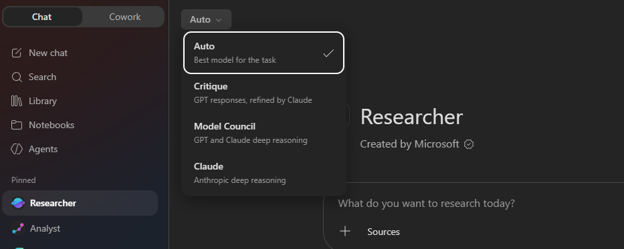
The important takeaway isn’t which model was used. It’s that users receive a higher-quality result without having to understand the growing complexity behind the scenes. As AI platforms continue to mature, model orchestration will increasingly replace manual model selection.
When Manual Model Selection Still Matters
Auto mode isn’t the right choice for every task. Some work genuinely benefits from more advanced reasoning models, particularly in software development, where debugging complex code, navigating large codebases, and designing architectures often require deeper analysis. These tasks involve ambiguity, planning, and multi-step reasoning that can justify the higher cost of a frontier model. The key is matching capability to the business need. Rather than defaulting to the most powerful option, organizations should ask a simple question:
Will advanced reasoning actually improve the outcome enough to justify the additional cost?
Sometimes the answer is yes. Often, it isn’t.
Choosing the Right AI Experience Matters More Than Choosing the Right Model
As AI platforms evolve, organizations are discovering that a more important decision than selecting a model is selecting the right type of AI experience.
Traditional chat interfaces are designed for quick interactions: drafting emails, answering questions, brainstorming ideas, summarizing meetings, or generating content. They remain the most cost-effective option because each interaction is relatively short and self-contained.
AI coworkers and autonomous agents are different. Whether it’s ChatGPT Work, Claude Cowork, Microsoft Copilot’s Researcher, or similar offerings from other vendors, these systems can search across multiple data sources, reason through complex problems, coordinate multi-step tasks, and produce more comprehensive work products with minimal supervision.
That additional capability also comes with higher compute costs. An agent may execute dozens of searches, invoke multiple AI models, consult enterprise data, and spend several minutes working on a task that a traditional chat session could never complete.
For many organizations, the first question shouldn’t be: “Which model should I use?” Instead, it should be:
“Am I using the right tool for this job?”
A simple document summary rarely needs an autonomous AI coworker. A competitive market analysis, merger due diligence project, or strategic research assignment might.
Choosing between chat and an AI coworker often has a greater impact on productivity and cost than choosing between GPT, Claude, or another frontier model.
When to Trust Auto Mode and When to Take Control
The decision isn’t really about which model is best. It’s about balancing capability, speed, and cost with the task’s needs. For many everyday activities, automatic model selection delivers excellent results. For more specialized or high-stakes work, manual selection may provide additional value.
Frequently Asked Questions
If you are trying to… | Use… |
|---|---|
Draft an email | Draft an email Standard AI chat |
Summarize meetings | Standard AI chat |
Brainstorm ideas | Standard AI chat |
Analyze hundreds of documents | AI coworker/Research agent |
Prepare executive research | AI coworker/Research agent |
Build a software architecture | Advanced reasoning model |
Solve a difficult coding problem | Advanced coding or reasoning model |
Perform financial or legal analysis and present the findings | Advanced reasoning model or Cowork type personal agent |
The Metric That Actually Matters
AI benchmarks measure technical performance. Businesses measure business performance.
The real question isn’t which model ranks highest on a leaderboard. It’s whether paying for a more capable model produces a better business outcome.
As AI adoption expands, organizations will increasingly evaluate metrics such as cost per completed workflow, productivity gains, customer experience, and return on investment. In many situations, the highest-performing model won’t deliver the highest value. The winner will be the model that provides the right balance of capability, speed, and cost for the work being done.
What This Means for Microsoft Copilot Users
Microsoft Copilot reflects where enterprise AI is headed. Rather than asking employees to choose among dozens of AI models, Copilot is increasingly making those decisions automatically. Depending on the task, it may draw on OpenAI, Anthropic, Microsoft’s own MAI models, or multiple models working together to optimize quality, response time, and cost. Features such as Researcher, Critique, and Model Council demonstrate how AI platforms are beginning to orchestrate multiple models behind the scenes.
For IT leaders, the focus shifts from model selection to business enablement. The priority is no longer deciding whether employees should use GPT-5, Claude, or another frontier model. Instead, it’s identifying the workflows where AI delivers measurable value and establishing governance that aligns AI capabilities with business needs. That includes determining when a standard chat experience is sufficient, when advanced reasoning is justified, and when autonomous AI agents generate enough additional value to justify their higher operating costs.
Focus Less on the Model, More on the Outcome
In a few years, most employees won’t know, or care, which AI model answered their question. They’ll simply expect AI to produce the right result. The organizations that gain the greatest advantage won’t be those that always use the smartest model. They’ll be the ones that consistently apply the right amount of intelligence to the right business problem at the right cost.
Generally, no. Modern AI platforms increasingly use automatic model selection to route requests to the most appropriate model based on the task, reducing complexity for end users.
Auto Mode is a capability that automatically selects the most appropriate AI model for a given request, balancing factors such as accuracy, speed, reasoning depth, and cost.
Manual selection is most valuable for specialized work such as software architecture, advanced coding, deep research, complex financial analysis, or other tasks where stronger reasoning can materially improve the outcome.
Standard chat is optimized for quick tasks such as drafting emails, summarizing meetings, and brainstorming. AI coworkers and research agents can execute multi-step workflows, search multiple data sources, perform deeper analysis, and generate more comprehensive work products.
Different workloads have different requirements. Some prioritize cost and speed, while others require advanced reasoning. Providers such as OpenAI, Anthropic, and Microsoft increasingly offer portfolios of models optimized for different use cases.
Not necessarily. A more capable model may produce a better answer, but if the improvement is marginal relative to the additional cost or time required, the business value may be lower.
Microsoft is increasingly using a multi-model approach that can incorporate OpenAI models, Microsoft’s MAI models, and selected third-party models. New capabilities such as Researcher, Critique, and Model Council demonstrate how multiple models can contribute to a single outcome.
For many everyday tasks, yes. As model routing becomes more sophisticated, organizations will focus more on business outcomes, governance, productivity, and cost than on the specific model generating the response.
A better question is: “Which AI option delivers the best outcome for this task at the lowest cost, time, and effort?” This perspective aligns AI decisions with business value rather than benchmark rankings.
Focus on metrics such as productivity gains, workflow completion rates, employee adoption, customer outcomes, governance requirements, and cost per completed task rather than purely technical benchmark performance.
The trend is toward greater abstraction. Users will increasingly interact with AI experiences while the platform automatically chooses and coordinates the most appropriate models behind the scenes.
Many organizations focus on finding the “smartest” model instead of determining whether they are using the right AI experience for the task. Choosing between chat, a reasoning model, or an autonomous agent often has a greater impact on ROI than choosing between individual models.
Turning AI Potential into Business Results
Choosing the right AI model is becoming less important than choosing the right AI strategy. The organizations seeing the greatest value from AI are focusing on business outcomes, governance, user adoption, and workflow transformation rather than chasing the latest model release.
Whether you’re evaluating Microsoft Copilot, AI agents, enterprise search, data readiness, or AI governance, Cerium can help you identify where AI can deliver measurable business value and where a simpler, lower-cost approach may be the better choice.
Talk with a Cerium AI Specialist about aligning your AI investments with business outcomes, not model hype.